Drone as First Responder & Public Safety UAS

How life-safety missions, like Drone as First Responder (DFR) programs, share airspace with other operators through UAS Traffic Management (UTM).

Sharing airspace via UTM

A growing need to digitally share airspace

Beyond Visual Line of Sight (BVLOS) drone operations are now common: retail and medical deliveries, infrastructure inspection, and drone as first responder. More and more, UAS operators need a streamlined way to deconflict from one another that does not depend on phone calls or manual coordination.

Digital services, known as UAS Traffic Management (UTM), are available today. These services have already managed conflicts across more than 1.5 million UAS flights with no safety incidents.

What UTM is

A digital-first approach to shared airspace

UTM services connect UAS operators to a shared network of participants. The network exchanges flight intent and other information to help keep the airspace safe and deconflicted.

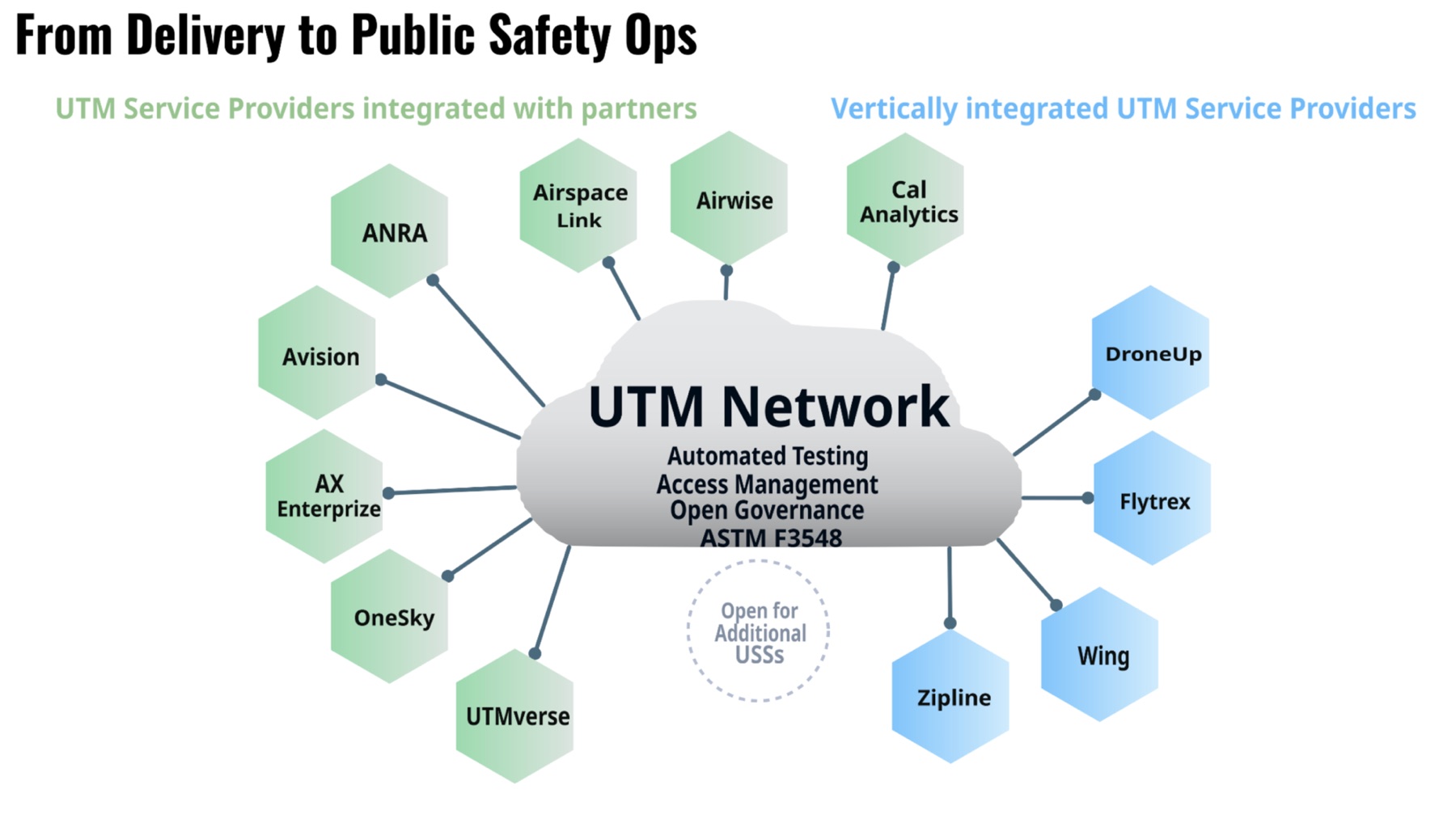
An operator connects to a single service provider. It is the responsibility of the UTM service providers to exchange data with all other providers across the network, so operators can stay focused on the flight of their aircraft.

The FAA provides regulatory oversight to ensure UTM service providers meet established safety, interoperability, and performance requirements.
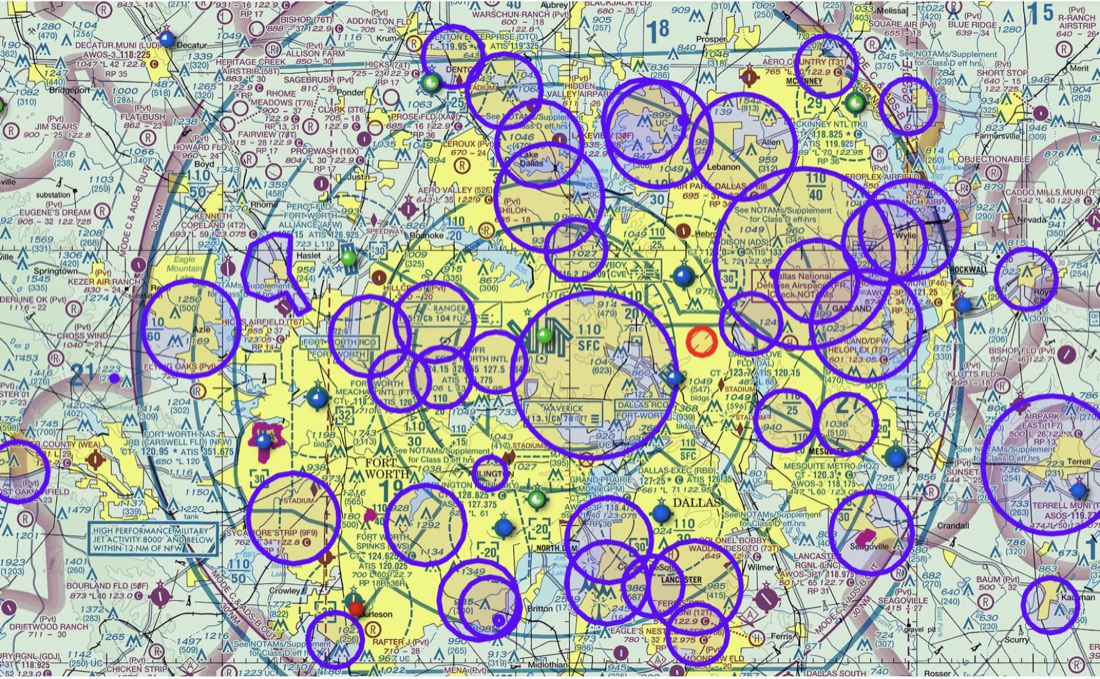
Sectional chart of the Dallas-Fort Worth area overlaid with dozens of circular UAS NOTAM areas
Dallas-Fort Worth UAS NOTAMs, April 10, 2026
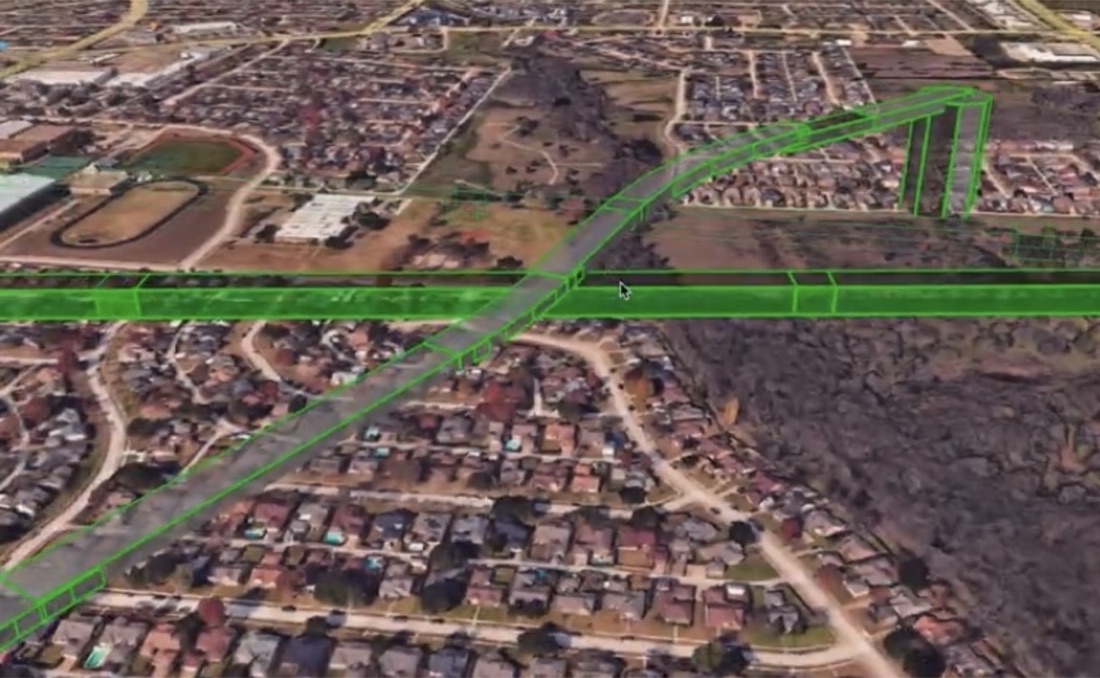
Aerial view of a suburban area with green 4D flight volumes drawn along roads and corridors
Shared Airspace 4D Flight Volumes
Getting involved

The Shared Airspace UTM Consortium

Established in 2024, the Shared Airspace UTM Consortium is a public-private partnership between drone operators, UTM service providers, and the Federal Aviation Administration (FAA). It manages conflicts between UAS operators with automated mechanisms that are designed to scale across the country.

Collaborative governance

The Implementation uses industry consensus standards to define how service providers and operators share data and manage operations. It sets cooperative operating principles and performance-based onboarding criteria.

About us

Verified services

A comprehensive automated test suite verifies each service. The result is a national framework for UTM deployment that assures equitable access to shared airspace.

See the onboarding path

Data exchange in practice

Participating BVLOS operators exchange operational volumes with each other by digital means to reduce the risk of collision. They also share their remote identification data with relevant stakeholders.

Read the policies
Available today

Two services, from a range of providers

At present, two services are implemented and available from a range of service providers through the Consortium. Service providers can make services available through an API endpoint, a web application, a custom interface, or by other means.

Strategic coordination

Strategic coordination helps UAS operators find out whether they will have a conflict-free route. Operators submit operational intent information, when and where they plan to fly. Service providers make sure that no unallowed conflicts, an overlap in space and time, exist, and digitally notify operators when a conflict is found.

UTM service providers also give operational priority to eligible UAS operators, including emergency response where safety of life is at stake.

Services that give strategic coordination must comply with the technical requirements in ASTM F3548-21. The FAA issues a Letter of Acceptance (LOA) to UTM service providers. The LOA signifies that the service can be used to manage conflicts between UAS, as required in many BVLOS waivers and exemptions, and in support of FAA Order 8040.6A.

Network remote identification

Network remote identification gives real-time position information about other nearby UAS. This can improve situational awareness about nearby UAS operators.

Services that give network remote identification must comply with the technical requirements in ASTM F3411-22a.

UTM and emergency response

What first responders get from the Implementation

BVLOS drone operations of all types, infrastructure, delivery, first response, continue to scale in the US National Airspace System. Collaborative, automated, and rapid mechanisms for airspace sharing will become standard aviation practice.

Awareness of who else is flying

When first responders onboard to the Implementation, they get awareness of active and planned operations in shared airspace. This includes operational volumes and network remote identification position data, through digital exchanges that UTM services facilitate.

Priority for life-critical missions

First responders have airspace access priority for life-critical missions. They can strategically deconflict their operations with other national, regional, and local operators and service providers that can share the same airspace.

Alignment with Part 108

The Consortium gives a means to drive airspace cooperation between operators, service providers, and the FAA. This aligns with the FAA's proposal for digital cooperative airspace in the upcoming BVLOS Part 108 rule.

How to participate

First responders already participate in the Implementation through partnerships with current service providers. Prospective first responders can participate by partnering with an existing or a new service provider.

Diagram titled From Delivery to Public Safety Ops. UTM service providers integrated with partners (ANRA, Airspace Link, Airwise, Cal Analytics, Avision, AX Enterprize, OneSky, UTMverse) and vertically integrated UTM service providers (DroneUp, Flytrex, Wing, Zipline) connect to a central UTM Network that provides automated testing, access management, open governance, and ASTM F3548 conformance, and remains open for additional USSs.
Part of a live network

The Implementation today

As of June 2026, the Implementation has participants that deploy and/or develop strategic coordination services to support operators in seven states.

19
Participants deploying or developing strategic coordination services
7
States supported:
AR, MI, NY, NC, OH, TX, UT
1.5M+
UAS flights with conflicts managed by UTM services, no safety incidents
2024
Consortium established
Resources

Where to go next